I became familiar with the writings of Pater in college. I was an English major. Maybe I should add that I'm an English major that was lucky enough not to go into real debt due my college education. While his poetry is something I was mostly drawn to then, I've recently re-visited his longer forms of writing—in particular, Studies in the History of the Renaissance—which seem to speak even louder now. If long form intimidates you (it does for me), and if you care about cultivating a worthy aesthetic of emotion around you, I recommend at least reading the preface. You will find immediate gems like below:
"The answers to these questions are the original facts with which the aesthetic critic has to do; and, as in the study of light, or morals, of number, one must realize such primary data for one's self, or not at all. And he who experiences these impressions strongly, and drives directly at the discrimination and analysis of them, has no need to trouble himself with the abstract question of what beauty is in itself, or what its exact relation to truth or experience—metaphysical questions, as unprofitable as metaphysical questions elsewhere. He may pass them all by as being, answerable or not, of no interest to him."
Walter touches on the very important notion that we all are capable of becoming critics. Art can be anything to anyone, we've all heard it's subjective. Some people talk about high art, high culture, implying there are levels – a goal possible, in seeing what is truly beautiful. This thought is controversial, of course, because that's basically saying there are smarter people out there and they don't just think there's a better way of seeing, they're somehow elevated themselves to appreciate things more than you. How unfair.
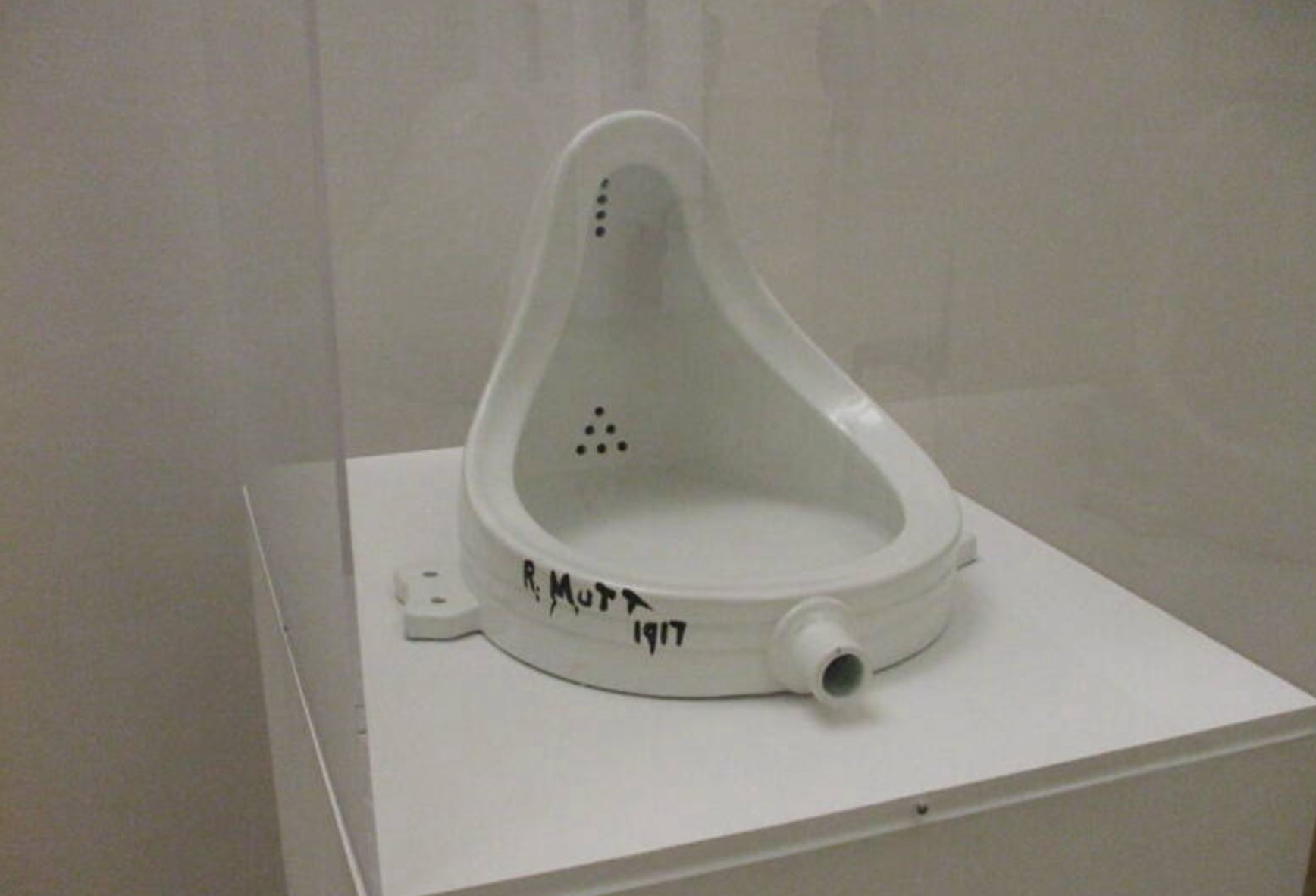
Perhaps an easy way to understand your current aesthetic appreciation level is: Do you like urinal art? Maybe you think like Brad Pitt does and see a silver stainless steel toilet as sexy. He's not wrong. He just likes toilets as art. Maybe he's right, actually. Maybe the lines of a metal toilet are… nice? Idk, I don't like staring at something that is used to collect shit. That's me projecting the use of something onto the thing itself though, I'm not saying you are trash if you like shitty containers. I'm saying my preference is I don't like the connotation. Brad Pitt may not even see the connotation, or he sees it, moves past it, and sees the steel. (Side note: I was privy to seeing Elizabeth Holmes's bathroom in her office—and yes I'm conscious of what an odd brag that is—when Stanford finished construction for Theranos' office in Palo Alto. She had a steel toilet! Pausing further commentary on this detail because I think Pater's ponderings are vastly more important than a critique, but even before she became newsworthy, for some reason that always confused me, who would prefer a cold steel toilet, the same type used in prisons? Not me, but that's subjectivity for you.)
Pater's words on how to approach subjectivity—and these come from the preface so you really don't have an excuse not to read it—are:
"To see the object as in itself it really is,' has been justly said to be the aim of all true criticism whatever; and in aesthetic criticism the first step towards seeing one's object as it really is, is to know one's own impression as it really is, to discriminate it, to realize it distinctly."
Funnily enough I was on a date, years ago, and this guy asked what I thought was the definition of art. I said it was subjective which, technically-speaking, I still do—but if someone were to ask me now, I think I'd color in my answer more. I'd steal from Pater, and paraphrase nicely, to say that art has levels, and the very best kind has a physical effect on your mood. Whether it relaxes you, or inspires you to think, there is a biological clocking of something bigger, more, beyond our tangible world.
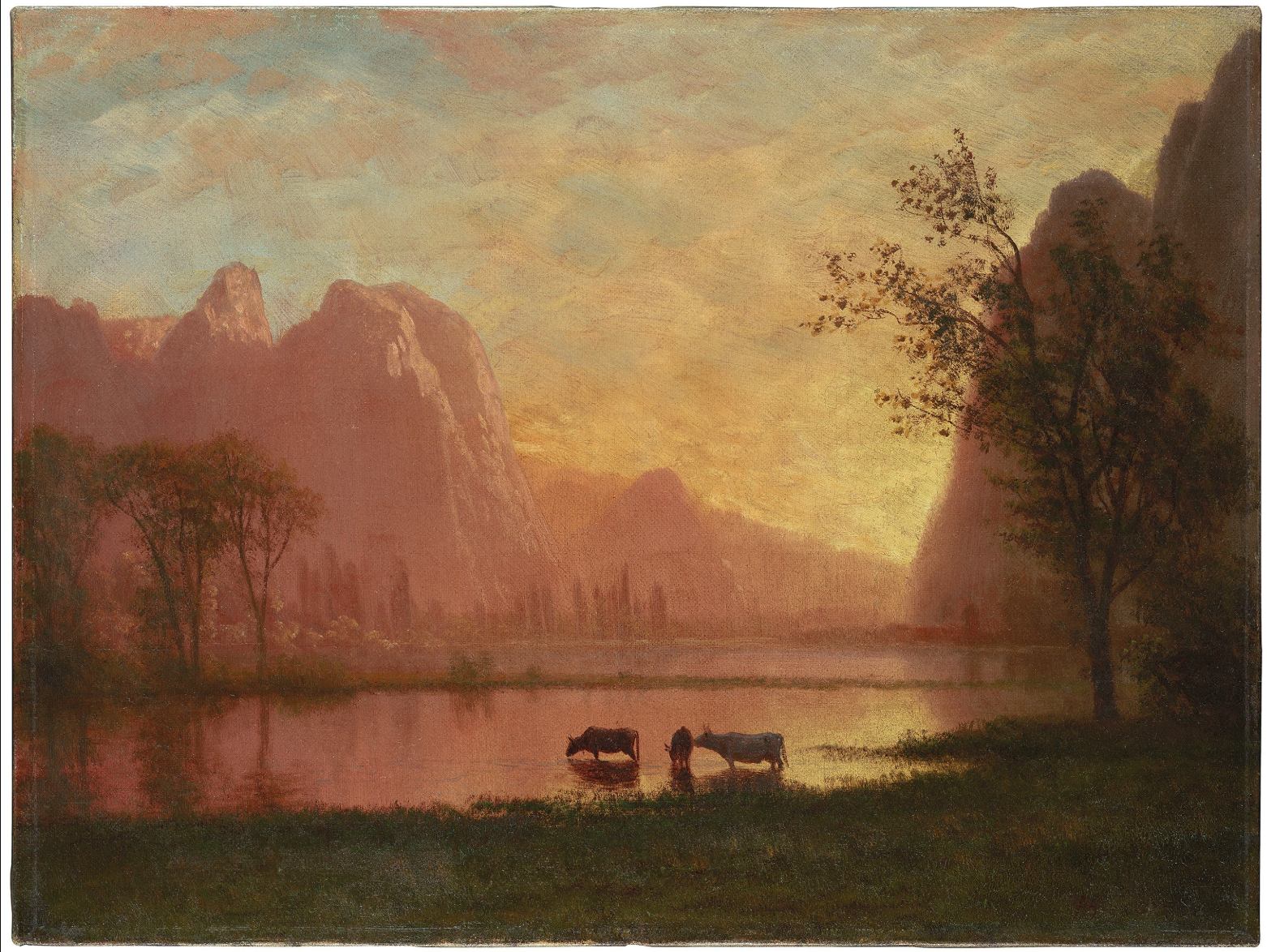
This is the art I like. I like it because I grew up with my grandparents, who had their honeymoon at the Ahwahnee Hotel in Yosemite (now it's called "Yosemite Lodge at the Falls"—omg what a colossal rebranding failure), and on their 50th anniversary we took a family trip back to it, when I was at the impressionable age of some year in middle school. Yosemite was beautiful, it was a happy time, and the hotel even honored the nightly rate of their fees in the 1930's or 40's. I forget when exactly my grandparents got married. Thus, you see into my subjectivity with the nostalgia of recollecting this landscape. I also love animals, so Albert Bierstadt throwing in a couple cattle at sunset is like drinking filtered water for my soul.
Poor Pater was probably rolling in his grave during the contemporary art movement that twisted beauty (in his eyes) into something else. Did we get so distracted away from pretty things that artists knew the only way back to them would be a jolt, a great big ugly feeling of something, at least? I don't know the art scene. Maybe the artists were doing that, the good ones, in an effort to make us feel that what we were looking at was the wrong type of emotion (shock + disgust = this is bad). I'm not the first person to say this. And remember as Pater highlights, badness is only relative to what you think is bad. He gives us crumbs of thought to make us realize that the purpose of all art—"music, poetry, artistic and accomplished forms of human life…"—is the making of a certain kind of feel good. That is his assertion, feeling itself can be a type of morality. In fact, part of what he's saying is it's the only type of morality we should pay attention to. Because who knows what right (good feelings) and wrong (bad feelings) really are. As long as we know what we feel, we should be alright. And everybody can do that, self-awareness is the key.
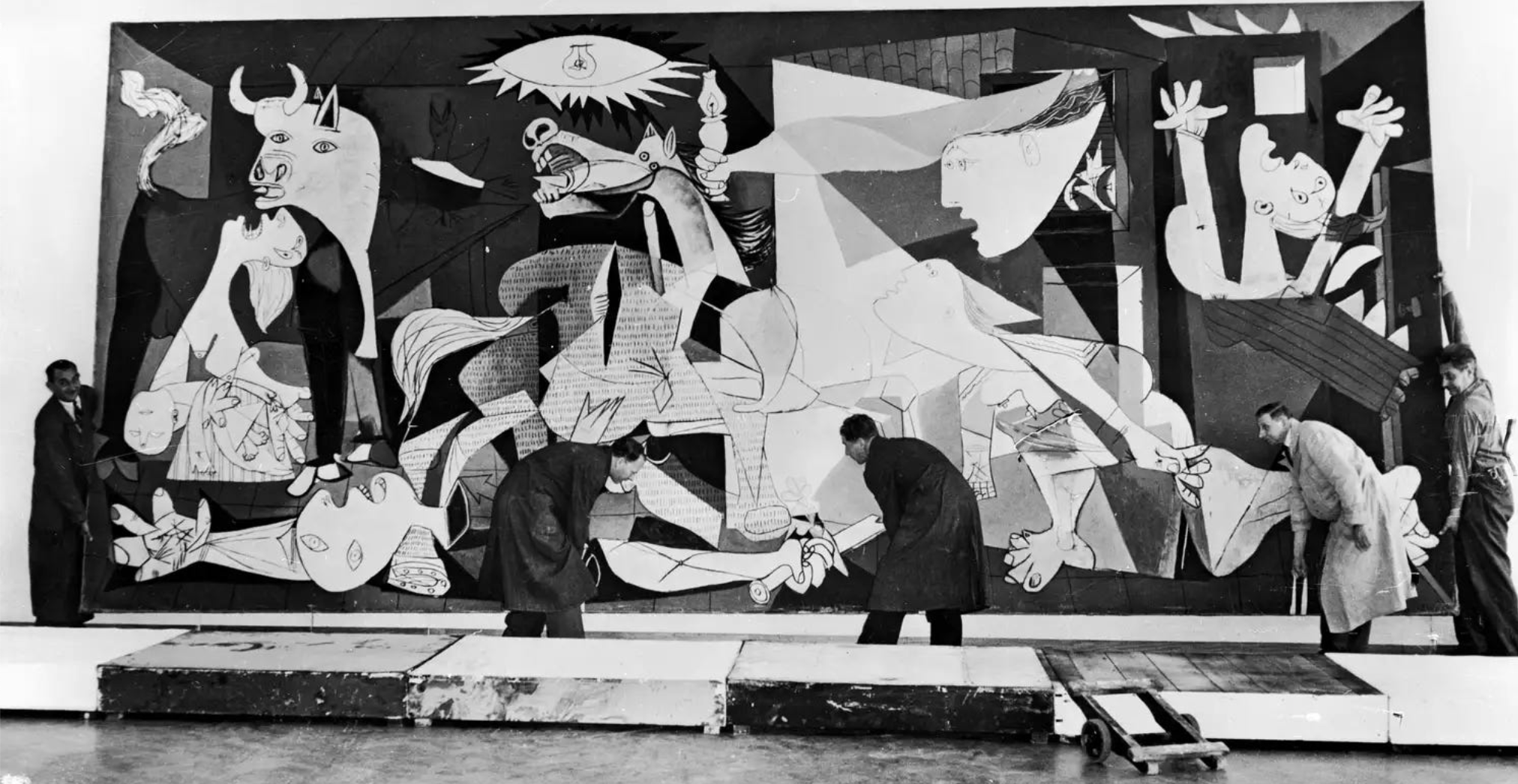
I think this is a good time to remind folks to stare at La Guernica. It's one of my favorites. When I lived in Madrid I got the chance to walk into the Reina Sofia and see this thing IRL and let me tell you, it's massive, it's size alone is incredible, and it perverts things in a beautiful way – that is possible for art to do (someone pls ask Brad Pitt if he sees toilets in this way). Looking at each detail of when Franco bombed the northern Spanish village of Guernica, stepping back, took energy. To take it all in simply isn't possible to do, wasn't at least for me, in the same visit. It haunted me so much that even when I went back to stare months later, I couldn't stay in the room for longer than 30 minutes. My mom used to say I'm too sensitive—but empaths know, once you know where to set boundaries, being sensitive is the only way to be. I suspect this feeling is experienced by many, and why this piece is considered one of Picasso's "best"—if art can be judged in levels.
While culture is always shifting, my college degree allows me to recall all the ways that poets have kept history in check, or highlighted the essence of what to pay attention to. I'm really grateful to this, and I feel for all the English majors in debt, who have less time to reflect on what they love as they worry about compounding interest. William Blake talks about taste and (if we are to believe in his written words as true), "…genius is always above its age." Walter Pater is wonderful to me because, in a way that I'm probably over-emphasizing, he invites everyone to the party, beauty is inclusive, as long as you have subjectivity, which everyone does, you belong. Anyone can be a genius if they know history (let's assume there's one version that's knowable). Anyone can grow their appreciation of art if they understand themselves well enough. I think this is a key point to pause on, given the current state of our dopamine-filled world, and the swift trajectory the "mental health movement" has taken—people are starting to feel the effects of what a lack of awareness does to the human psyche. And this, Pater knows well. He emphasizes the importance of knowing our temperament. If we can keep attention to that, we can recognize "good thoughts" and "common character" (his words) – whatever types they are, and having them as guiding posts will naturally orient us in our right direction.